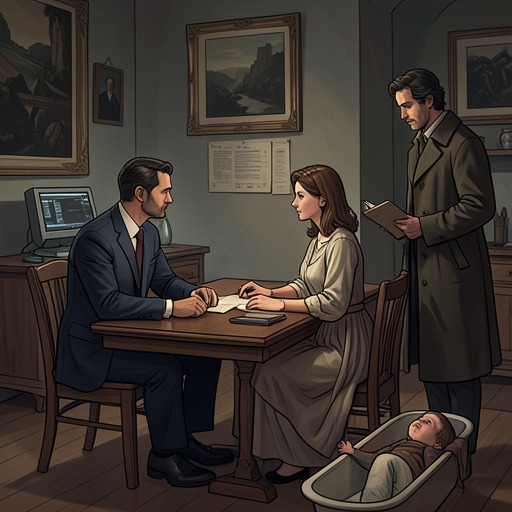
Superintendent Spence
Hallowe'en PartySuperintendent Spence is Hercule Poirot’s former colleague in police work, now living at Pine Crest and occupied with weeds rather than murder. His reunion with Poirot turns a quiet visit to a hilltop garden into a renewed investigative partnership: Spence contributes local knowledge, a record of the party, and information about an earlier criminal case, while Poirot develops the decisive explanation of Joyce Reynolds’s death.
Identity and Introduction
When Poirot reaches Pine Crest, he finds a neat, modern house on a hill planted with sparse pines, with a small garden and a path along which an elderly man is pushing a large watering can. The man is Spence. His hair, once grey only at the temples, has become entirely grey, though he has changed little in girth. The measured domestic scene gives a visible contrast to the murder investigations that once connected the two men: Spence is now among his garden plants, and Poirot has to catch his breath after reaching the gate.
Spence recognizes Poirot with astonishment and pleasure. Their greeting is affectionate and familiar, but their circumstances have shifted. Spence has taken up weed-killing and complains that the work is less straightforward than it appears: the weather must be neither too wet nor too dry, and something is always going wrong. His attention to the stubborn practicalities of gardening supplies a wry counterpart to Poirot’s more abstract reconstruction of crime.
A Changed Social World
Spence initially presents himself as finished with murder, except for the weeds he is trying to eliminate. The claim is a conversational refusal rather than a formal account of retirement: when Poirot asks for help, Spence soon recognizes the familiar pattern of someone seeking his assistance. He recalls that he himself once came to Poirot wanting him to do something. Now Poirot has reversed the direction of that earlier appeal and come to Spence.
Their conversation also gives Spence room to reflect on changing family and social arrangements. He contrasts an earlier world in which mothers, aunts, older siblings, and fathers knew more about young people’s relationships with a present in which parents may not know whom their daughters are seeing. In his account, couples can seek a magistrate’s permission to marry when their parents withhold consent, and a young woman may then lie for a husband whose criminal tendencies become apparent. Spence presents this as a difficulty for those trying to judge people, not as a simple claim that the past was better; he concedes that perhaps it only seemed better. His remarks establish his scepticism about easy judgments of character, while also making clear that this is his general view of social change, not evidence about any particular person in the case.
Poirot explains that he is still based in London and has become involved at the request of Ariadne Oliver, a friend. Spence does not remember her. The small lapse underscores the difference between the men’s shared professional past and Poirot’s present route into the case: the investigation has arrived through a person Spence does not know, but through a kind of problem he recognizes.
Local Knowledge and Investigative Cooperation
Poirot asks Spence to help him understand the people connected with the Halloween party: its guests, the children’s parents, and the local school, teachers, lawyers, and doctors. The request is deliberately broad. Poirot needs more than an abstract theory about a child’s boast; he needs the local relationships and circumstances through which that boast might be tested. Spence first says there is nothing he can do, then accepts the practical usefulness of his knowledge.
The exchange becomes more focused when Poirot describes the possibility that someone used the apple-bobbing game to push a girl’s head under water. He connects Joyce’s boast that she had witnessed a murder with her death only hours later, while keeping the proposed link tentative. Spence responds decisively to the timing and asks how many people were present when Joyce made the statement. Poirot can offer only an estimate: about fourteen or fifteen people, including five or six children and five or six adults helping to run the party. Spence says that exact information should be easy to obtain from local people. His contribution is characteristic: he turns a disturbing possibility into a concrete inquiry about who was there.
Spence already knows the broad shape of the gathering. He describes it as attended mainly by women; fathers seldom came to children’s parties, though some might look in or arrive to collect their children. Dr Ferguson and the vicar were present, along with mothers, aunts, social workers, and two teachers from the school. Spence estimates roughly fourteen children, ranging from the youngest at about ten to teenagers. These details do not by themselves identify a killer, but they define the group whose accounts and movements matter to Poirot’s question.
Earlier Cases and the Limits of Reputation
Spence also supplies background about Lesley Ferrier, whose earlier criminal history complicates any simple reading of respectability. Ferrier had falsified accounts and committed forgery in his early twenties. He was said to have come from a broken home; his employers spoke up for him, and after serving a short prison sentence he was taken on by Fullerton, Harrison and Leadbetter. Spence says that nothing further was proved, and that Ferrier appeared to have gone straight as far as his employers were concerned, yet he had been involved in questionable transactions with friends. Spence’s description keeps the distinction between suspicion and proof in view: Ferrier had a dubious reputation, but the later dealings were not established as crimes.
That distinction fits the wider investigative problem. Spence can offer what he knows of local people and their histories, but a reputation cannot settle what happened at the party. His usefulness lies partly in making information available and partly in recognizing how easily a plausible account can be mistaken for a reliable one. The case requires observations to be checked against circumstances rather than accepted simply because they come from someone who seems trustworthy.
The Water Clue and Spence’s Narrative Role
Poirot’s eventual explanation makes water the key to Joyce’s murder. Whoever held a vigorous child’s head beneath water in a full bucket would be splashed and soaked; the murderer therefore needed an innocent explanation for being wet. Rowena Drake took Joyce away to the library while the others were occupied with the Snapdragon in the dining room. Later, she used a large water-filled vase as cover, staging its fall so that it soaked her clothes and broke on the hall floor. Elizabeth Whittaker witnessed the apparent accident and was left with the impression that Rowena had seen someone emerge from the place where a murder had occurred.
The sequence also exposes the danger of treating a witness’s interpretation as identical to what the witness actually saw. Whittaker observed Rowena carrying the vase, pausing on the stairs, dropping it, and becoming wet; the idea that she had seen a murderer was an impression Rowena cultivated. Miss Emlyn recognized the significance of Whittaker’s account and encouraged her to tell Poirot. Poirot then connected the staged wetness to the physical consequences of drowning Joyce. The supposed eyewitness who prompted the chain of events had not, in fact, seen a murder. Rowena had feared that somebody might have witnessed her and Michael Garfield killing Olga Seminoff in Quarry Wood, and Joyce’s boast seemed to confirm that fear, although Joyce knew nothing of that crime.
Spence’s part in this resolution is not that he announces the culprit or discovers the water clue. Rather, the evidence shows him returning to the work he claimed to have left behind: he helps Poirot frame inquiries, identifies the party’s broad social composition, and makes precise local information obtainable. The partnership links Poirot’s inference from physical details to Spence’s practical knowledge of the community. His shift from tending weeds to assisting an inquiry is the quiet measure of his continuing value to the investigation.